
• Skip to main content
  • Skip to secondary menu
  • Skip to primary sidebar
  • Skip to footer
BlackDoctor.org
Where Wellness & Culture Connect

Where Wellness & Culture Connect

  • Conditions
  • Wellness
  • Lifestyle
  • Longevity
  • Clinical Trials
  • Resources
    • Generational Health
    • Top Blacks in Healthcare 2025
    • Hall Of Fame
    • Clinical Trials Resource Center
    • Obesity Resource Center
    • Cancer Resource Center
    • Wellness on the Yard
    • Immunocompromised Care
    • BDO Resource Library
  • Find A Doctor
  • BDO TV
Home / Health Conditions / Breast Cancer / Fewer Black Women Are Dying from Breast Cancer—Here’s Why

Fewer Black Women Are Dying from Breast Cancer—Here’s Why

breast cancer

The numbers are stark: Black women are about 40 percent more likely to die from breast cancer compared to white women, even though they are diagnosed at similar rates. This isn’t just a statistic; it represents systemic barriers that Susan G. Komen is fiercely working to tear down.

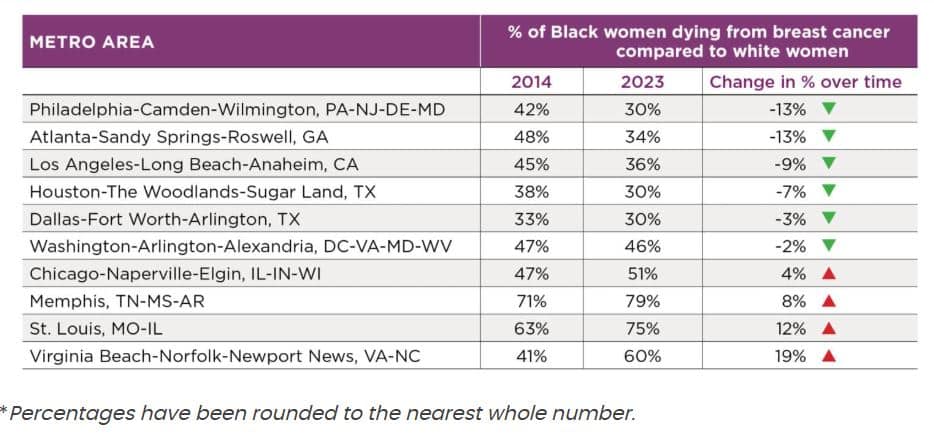
BlackDoctor spoke with Dr. Sonja Hughes, an experienced OB-GYN and Vice President of Community Health at Susan G. Komen, about the hopeful news from Komen’s recent analysis (comparing 2014 and 2023 data by the Centers of Disease Control and Prevention (CDC) and National Cancer Institute (NCI)), which reveals that fewer Black women died of breast cancer in nine of 10 major metro areas studied.

“Our recent update indicates we’re making some progress. In some of the cities, the gap improvement was double-digit,” Dr. Hughes says. 

You May Also Like

Psoriatic Arthritis Can Feel Beyond Your Control. Consider a Different Direction. Learn More Here. Psoriatic Arthritis Can Feel Beyond Your Control. Consider a Different Direction. Learn More Here.

This progress shows that when resources are targeted, lives are saved. However, the fight isn’t over. In areas like Memphis (79 percent more likely to die) and St. Louis (75 percent more likely to die), the disparity remains alarmingly high.
Your Empowerment Plan: Tools and Resources from Komen

Komen’s strategy is designed to meet you, the patient, wherever you are on your health journey, offering support that is both culturally sensitive and directly actionable.

You May Also Like
Get GLP-1s Delivered to You As Low As $99/Month! Get GLP-1s Delivered to You As Low As $99/Month!

1. Personalized Support and Guidance

  • The Helpline is Your First Advocate: If you have questions about screening, need emotional support, or are facing financial hardship (like paying for transportation or housing), call the national helpline at 877-GO-KOMEN (877-465-6636). They are ready to connect you with resources, including financial assistance.
  • A Navigator Who Understands You: Komen’s Patient Care Center offers culturally sensitive patient navigation. You can be paired with a navigator who may share a similar background, ensuring the guidance you receive is relevant and supportive.

2. Knowledge is Power: Know Your Body, Demand Your Care

Dr. Hughes offers three crucial steps for every woman to take charge of her health:

  1. Know Your Normal: Make it a habit to know how your breasts look and feel regularly. If you notice any change, large or small, discuss it with your healthcare provider immediately.
  2. Know Your History: Be prepared to discuss your family health history (on both your mother’s and father’s sides) with your provider. This history is key to determining the right age and type of screening you need.
  3. Demand What You Deserve: Komen’s research revealed that many Black women were not being offered the same life-saving screenings or genetic testing as others. If you believe you need a screening based on your history, speak up and ask for it. Your health is worth advocating for!

RELATED: Closing the Gap: How Black Women Are Leading the Fight Against Breast Cancer

“What we learned and what the data reports is that many times Black women are not offered some genetic screening that others are. That has improved over time. We did two specific programs, one in Dallas and one in Philadelphia, working with a healthcare system where we had features to actually work with the healthcare systems there to be the recipients of genetic screening to find out if they were at increased risk for breast cancer. And the providers, as well as the patients, were astonished by how many women would actually accept that genetic screening. They had not been offered that before,” Dr. Hughes adds.

3. Join the Fight for Better Science

  • The ShareForCures Registry: Your experience can help save future lives. Komen is asking any breast cancer patient to securely share their health records with this registry. This is vital to ensuring scientists can study how the disease specifically affects Black women and develop more effective, personalized treatments.

A Shared Responsibility for Equal Outcomes

The progress seen proves that interventions work. Dr. Hughes encourages everyone to join the effort:

  • Community: Look for Komen’s Worship in Pink program, which brings life-saving education directly into faith-based organizations.
  • Action: Komen continues to work on policy changes to remove systemic barriers to care, because every woman deserves equitable access to healthcare.

Dr. Hughes’s message is clear: You are the most important member of your care team. By taking charge, utilizing Komen’s resources, and demanding equitable care, you are helping to close the gap for every woman.

“Breast cancer is something that takes all of us. It doesn’t matter what you look like, where you go to worship, or who you love. Everyone deserves fair and equitable access to healthcare. But ending breast cancer takes all of us, so certainly Komen is on that journey with the patients and with the community,” Dr. Hughes concludes.


By Jasmine Smith | Published October 22, 2025

October 22, 2025 by Jasmine Smith

The Latest In Breast Cancer

family history

Make Collecting Family Health History Part Of Your Thanksgiving Plans

For some, being home for the holidays means lots of extra family time, often with multiple generations coming together to celebrate under one roof. Most likely, your conversations at this time will center around what’s new at work or what read more about Make Collecting Family Health History Part Of Your Thanksgiving Plans
Why I Did a Trial for TNBC: "It Very Likely Saved And Extended My Life"

Why I Did Clinical Trials for TNBC: “It Very Likely Saved And Extended My Life”

My cancer journey began in 2015 during a routine mammogram that revealed a mass in my breast, which turned out to be Triple-Negative Breast Cancer (TNBC), a rare and aggressive form of the disease. In my 50s and coming from read more about Why I Did Clinical Trials for TNBC: “It Very Likely Saved And Extended My Life”
dense breasts

Have Dense Breasts? Here’s Why a Standard Mammogram Might Not Be Enough

Breast cancer is the most common cancer in women globally. In the United States, about one in eight women will be diagnosed with breast cancer at some point in their lives.  Breast cancer screenings—such as self-exams and mammograms—are crucial for read more about Have Dense Breasts? Here’s Why a Standard Mammogram Might Not Be Enough
Understanding Breast Cancer Clinical Trials for Black Women

Understanding Breast Cancer Clinical Trials for Black Women

Breast cancer is a type of cancer that starts with the growth of cells within the breast tissue.  Several types of breast cancer exist, including:  Ductal carcinoma in situ Invasive breast cancer Triple-negative breast cancer Inflammatory breast cancer Paget disease read more about Understanding Breast Cancer Clinical Trials for Black Women
inflammatory breast cancer

Inflammatory Breast Cancer Symptoms: What Every Woman Should Know

  Inflammatory breast cancer is rare, but it’s aggressive and fast-growing. It can show up suddenly, progress quickly, and may be harder to detect early than other forms of breast cancer. That's why knowing the inflammatory breast cancer symptoms can read more about Inflammatory Breast Cancer Symptoms: What Every Woman Should Know
This Black Woman Went From Stage 3 Breast Cancer to Clinical Trials Advocate

This Black Woman Went From Stage 3 Breast Cancer to Clinical Trials Advocate

Javonne Williams' life took an unexpected turn in 2022 when she received a devastating diagnosis: stage three breast cancer. The news was a shock, but Williams faced her diagnosis with determination. She underwent an aggressive treatment plan, including a double read more about This Black Woman Went From Stage 3 Breast Cancer to Clinical Trials Advocate

Primary Sidebar

Subscribe to our newsletter

Icon

Caring for You, Too - Caregiver Workbook

1 file(s) 297 KB
Download

Trending Articles

10 Foods Your Liver Wishes You Would Would Stop Eating

healthy liver

The 7 Most Dangerous Leftovers to Reheat Are…

leftovers

Weight Loss Challenge: Lose 10 Pounds In 2 Weeks!

lose 10 pounds in 2 weeks

Secrets For A Non-Damaging Silk Press

silk press

Stage 4 Lung Cancer: Why I Said Yes to a Clinical Trial

Stage 4 Lung Cancer: Why I Said Yes to a Clinical Trial
Find a Culturally Sensitive Doctor

Footer

Where Wellness & Culture Connect

BDO is the world’s largest and most comprehensive online health resource specifically targeted to African Americans. BDO understands that the uniqueness of Black culture - our heritage and our traditions - plays a role in our health. BDO gives you access to innovative new approaches to the health information you need in everyday language so you can break through the disparities, gain control and live your life to its fullest.

Connect With Us

Resource Centers

  • Top Blacks in Healthcare
  • Clinical Trials
  • Wellness on the Yard
  • Cancer
  • Immunocompromised Care
  • About Us
  • Privacy Policy
  • Cookie Policy
  • Terms of Service
  • Careers
  • Advertise With Us
  • Advertising & Sponsorship Policy
  • Daily Vitamina
  • TBH

Copyright © 2025, Black Doctor, Inc. All rights reserved.