Post-stroke mobility loss can lead to difficulty walking after a stroke and having to learn to walk again. Check out this post about regaining balance and mobility and how long it takes to walk after a stroke.
Within minutes, a stroke can ravage your brain, potentially robbing you of a world of skills that, until now, you've taken entirely for granted. Among the precious things you may lose is the ability to walk -- at least at the beginning.
"It was frustrating and scary. I couldn't stand or move," recalls Melanie Goldberg*, who suffered her stroke at the age of 52. "Basically you want to be independent and take care of yourself," Goldberg says. "But the staff had to help me onto a commode or into a wheelchair."
You May Also Like
Loss of mobility is just one of the effects a stroke can have. Post-stroke paralysis can require physical therapy or rehab to regain mobility and balance. Due to a stroke's major physical effects and recovery timeline, it is important to recognize warning stroke signs.
Why is walking affected by a stroke?
The majority of strokes injure the motor fibers connected to movement. Typically, strokes damage portions of one side of the brain and affect the opposite side of the body. A stroke can make one side of the body weak or paralyzed, making it difficult or impossible to walk. A stroke patient may also experience a complete lack of sensation in parts of the body.
"When you put your foot on the floor, you can feel it. They can't," explains Jen Aanestad, a physical therapy supervisor at St. Francis Memorial Hospital Acute Rehabilitation Center in San Francisco. "If you can't feel where your foot is in space, that's a huge deficit."
You May Also Like

A patient's balance may also be shaky, if the cerebellum -- the part of the brain that controls equilibrium -- is injured. And along with the paralysis, weakness, numbness, and loss of balance, many stroke patients are left with distorted perceptions about where the body ends. "They don't have an idea that the affected part of their body exists anymore," says Aanestad.
Damage to the optic nerve, for example, can shrink one's field of vision, so that a stroke survivor may see only half of their body when they look in the mirror. Interestingly, the other half of the body will come into view if the head is turned the other way, but patients often have to remind themselves to turn so they can "find" that half in the mirror.
Injury to the motor portion of the brain can also diminish muscle tone and control, another obstacle to walking. Muscles can lose the ability to contract altogether or, on the contrary, become overly contracted and too rigid to allow a simple walking motion.
Physical effects of a stroke that impact balance/coordination/mobility/walking:
- Muscle weakness/paralysis
- Foot drop
- Fatigue/tiredness
- Pain due to damage to tissues/nerves
- Spacticity
- Contractures
- Changes in sensation
Can a person walk again after a stroke?
After a stroke, most patients can walk again within the first six months or, in cases where mobility has been severely compromised, within the first two years. According to experts, the likelihood of regaining function after a stroke increases with the intensity of rehabilitation.
How long does it take to walk again after a stroke?
The majority of improvements happen within the first six months of the initial stroke. For stroke survivors who suffer from aphasia (25% to 40%), it can take up to two years to fully regain their speaking ability.
Recovery timeline:
- 5-6 weeks: Intense physical therapy/rehabilitation
- 3 months: Majority of recovery ending in a plateu
- 6 months: Gait improves
- 2 years: 74% of patients should be able to walk
Your rehabilitation should start as soon as you are stable. That could be anywhere from a couple of days to a few weeks or longer. Established guidelines, as well as a huge body of literature, insist that the earlier therapy is initiated, the better the caring after stroke will be. Additionally, the American Heart Association stresses the importance of aerobic and strengthening exercises to improve overall health and reduce the risk of subsequent strokes. Walking is one step towards that goal.
RELATED: Walking After a Stroke Can Boost Survival
Physical therapy steps to walk again

1. First step: Pinpoint weaknesses
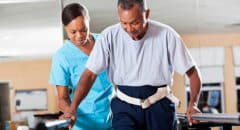
Before walking is even considered, a physical therapist will pinpoint weaknesses in the body that need to be addressed. First, the therapist may guide you through pre-walking exercises to prepare other pertinent muscles. If your trunk muscles were affected, causing them to lean to one side or to the front, Aanestad says, she would start with trunk exercises in the sitting position. The next step might be to work on standing until you feel anchored and secure.
2. Second step: Act of walking
Then, your therapist can help you approach the act of walking itself, which involves scores of muscles and many isolated movements. There are eight major phases of movement that occur with each step. Often, part of the complexity of relearning to walk is that each segment must be relearned separately, then combined, as if you were a beginning dancer learning a new piece of choreography. That is why it is essential for a therapist to make walking safer for stroke patients.
3. Third step: Sensory input
Usually, the brain tells the muscles in your body how to move, and they comply. Following a stroke, the process often works in reverse. The physical therapist creates sensory input for the brain. He or she repetitively uses their hands and body to move your muscles, if you aren't able to move them alone. This process sends messages back to the brain until the movement is relearned.
How common is fear of walking after stroke?
Many patients develop a fear of walking after a stroke due to the risk of falling. Fear of falling could be caused by accurate perceptions of impaired balance ability and unrealistic beliefs about one's risk of falling. The fear of falling in people with a history of stroke can be effectively reduced by balance training, according to research.
Another intervention, cognitive behavior therapy (CBT), aims to change irrational beliefs that can fuel unfavorable feelings and actions. By changing these self-defeating beliefs, CBT can lessen fear-avoidance behavior and its negative effects, such as restricted social interaction.
One of the social skills that many stroke survivors struggle with is the ability to communicate. A hands-on therapeutic approach is particularly important for stroke survivors suffering from receptive aphasia, a condition in which all language sounds like gibberish.
A person with receptive aphasia can't process the therapist's directions, so "I'll place my hands at the pelvis muscles to tell them where to move. I'm constantly facilitating the appropriate muscles," says Aanestad. "Even if they may not be cognizant of what I'm saying, I'm working with the part of their brain that deals with movement."
For other impairments in thinking, a physical therapist has to devise different ways of getting the message across. Aanestad recalls the way one client was able to translate her request to straighten his knee. "One guy said, 'Oh you want me to stand like a flamingo,' so that's what I'd say to him to get him to do it," she says.
You may also need your own verbal cues. "You're trying to get your muscles to remember what they're supposed to do, and you have to consciously tell them" -- sometimes out loud -- "which is very strange," says Goldberg of her first attempts to walk following her stroke.
Regardless of how you learn to walk, one thing is certain: there is no singular way to reintroduce walking into your live. "You have to have as big a bag of tricks as you can," says Aanestad.
The months or years it takes may seem overwhelming, but survivors like Goldberg keep in mind that the potential for progress is always there. "If I couldn't park right in front of where I was going, a couple years ago I couldn't go there," she says. "I still don't have the total use of my arm or leg. But now if I have to walk two blocks, I can do it."
RELATED: What You Don’t Know About Strokes Could Kill You
Key Takeaway: What to Expect
Post-stroke mobility loss can lead to difficulty walking after a stroke and having to learn to walk again. After a stroke, most patients can walk again within the first six months or, in cases where mobility has been severely compromised, within the first two years. Though recovery takes time, walking is the first step a stroke survivor can take toward achieving a full recovery.
* Melanie Goldberg is a pseudonym.