• Skip to main content
  • Skip to secondary menu
  • Skip to primary sidebar
  • Skip to footer
BlackDoctor.org
Where Wellness & Culture Connect

Where Wellness & Culture Connect

  • Conditions
  • Wellness
  • Lifestyle
  • Longevity
  • Clinical Trials
  • Resources
    • Generational Health
    • Top Blacks in Healthcare 2025
    • Hall Of Fame
    • Clinical Trials Resource Center
    • Obesity Resource Center
    • Cancer Resource Center
    • Wellness on the Yard
    • Immunocompromised Care
    • BDO Resource Library
  • Find A Doctor
  • BDO TV
Home / Lifestyle / Black History of Health / Kwanzaa: What It Really Is And How & Why It’s Celebrated

Kwanzaa: What It Really Is And How & Why It’s Celebrated

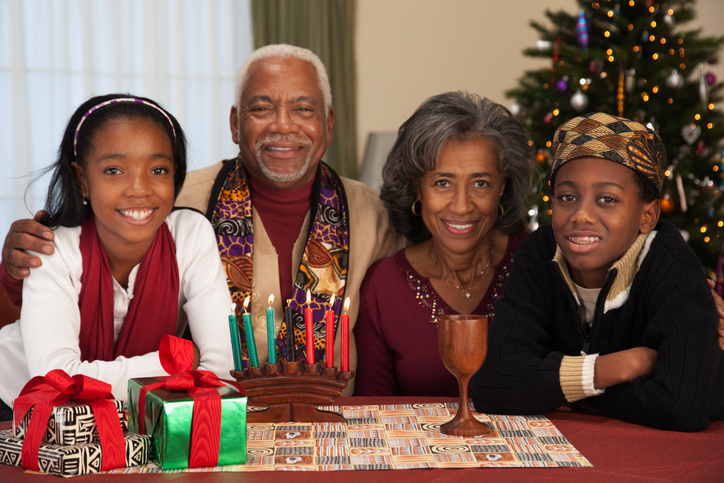
African couple with grandchildren celebrating KwanzaaEvery year, around Christmas time, you may hear some Black folks talking about celebrating Kwanzaa.  many of them jokingly because they don't know the history or roots behind the holiday. Here's how it all came about and why celebrating it could be more important than ever.

Maulana Karenga created Kwanzaa in 1966, as the first specifically African-American holiday. According to Karenga, the name Kwanzaa derives from the Swahili phrase matunda ya kwanza, meaning "first fruits of the harvest". The choice of Swahili, an East African language, reflects its status as a symbol of Pan-Africanism, especially in the 1960s, although most of the Atlantic slave trade that brought African people to America originated in West Africa.

Kwanzaa is a celebration that has its roots in the black nationalist movement of the 1960s and was established as a means to help African Americans reconnect with their African cultural and historical heritage by uniting in meditation and study of African traditions and Nguzo Saba, the "seven principles of African Heritage" which Karenga said "is a communitarian African philosophy". Karenga believed and stated that "you must have a cultural revolution before the violent revolution. The cultural revolution gives identity, purpose and direction."
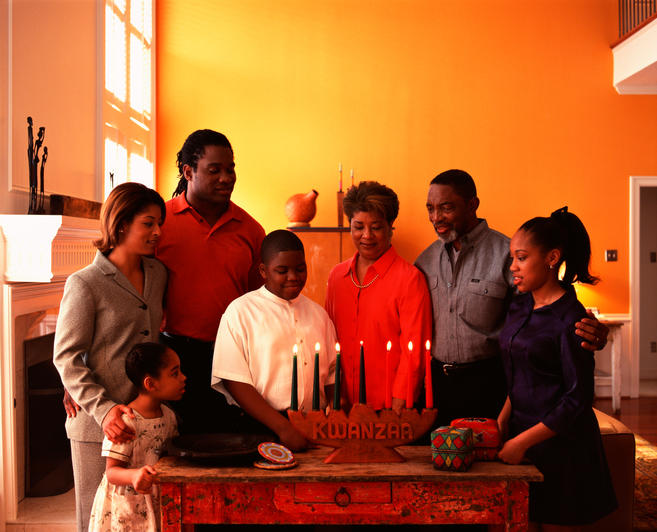
Family celebrating Kwanzaa

You May Also Like
Psoriatic Arthritis Can Feel Beyond Your Control. Consider a Different Direction. Learn More Here. Psoriatic Arthritis Can Feel Beyond Your Control. Consider a Different Direction. Learn More Here.

Kwanzaa was not created to give people an alternative to their own religion or religious holiday. Many African Americans who celebrate Kwanzaa do so in addition to observing Christmas.

Kwanzaa spans over seven days with each day focusing on a specific principle in the Black community. A Kwanzaa ceremony may include drumming and musical selections, libations, a reading of the African Pledge and a discussion of the African principle of the day or a chapter in African history and a feast known as the "karamu."

Each day also consists of a candle-lighting ritual. You have what is called a kinara (candle holder) and seven candles (one black candle, three green candles and three red candles). The black candle is lit first then used to light each of the other candles on the day that is celebrated, going back and forth with lighting the red and green.

You May Also Like
Get GLP-1s Delivered to You As Low As $99/Month! Get GLP-1s Delivered to You As Low As $99/Month!

The seven principles of Kwanzaa are as follows:

1. Umoja (Unity):

To strive for and to maintain unity in the family, community, nation, and race.

2. Kujichagulia (Self-Determination):

To define and name ourselves, as well as to create and speak for ourselves.

3. Ujima (Collective Work and Responsibility):

To build and maintain our community together and make our brothers' and sisters' problems our problems and to solve them together.

4. Ujamaa (Cooperative Economics):

To build and maintain our own stores, shops, and other businesses and to profit from them together.

5. Nia (Purpose):

To make our collective vocation the building and developing of our community in order to restore our people to their traditional greatness.

6. Kuumba (Creativity):

To do always as much as we can, in the way we can, in order to leave our community more beautiful and beneficial than we inherited it.

7. Imani (Faith):

To believe with all our hearts in our people, our parents, our teachers, our leaders, and the righteousness and victory of our struggle.

Besides the candles and the candle holder, other Kwanzaa celebratory symbols include a mat (Mkeka) on which other symbols are placed: a Kinara (candle holder), Mishumaa Saba (seven candles) mazao (crops), Muhindi (corn), a Kikombe cha Umoja (unity cup) for commemorating and giving shukrani (thanks) to African Ancestors, and Zawadi (gifts). Supplemental representations include a Nguzo Saba poster, the black, red, and green bendera (flag), and African books and artworks - all to represent values and concepts reflective of African culture and contribution to community building and reinforcement. With corn being the primary symbol for both decoration and celebratory dinning.

The greeting for each day of Kwanzaa is Habari Gani? which is Swahili for "What's the news?" or "How are you?"

By Derrick Lane | Published December 26, 2021

The Latest In Black History of Health

black history

5 Milestones in Black Health History

Few people realize it, but Black history is steeped in health and wellness discoveries. Not just discoveries, but also negative events that have affected the course of Black health history. From dangerous experiments on Black men to the founding of read more about 5 Milestones in Black Health History
James Brown

Black History of Health: James Brown

When James Brown died on Christmas Day 2006 at age 73, officials at Atlanta's Emory University Hospital Midtown cited congestive heart failure as the cause of death. Nearly a decade later, the medical team that signed Brown’s death certificate says read more about Black History of Health: James Brown
Michael Jackson

Black History of Health: Michael Jackson

MJ. The King of Pop. The pop music legend. Micheal Jackson. Most of us know that Michael Jackson is the King of Pop, the youngest of his brothers in the Jackson 5, and the most-awarded artist of all time. He read more about Black History of Health: Michael Jackson
Muhammad Ali

Black History of Health: Muhammad Ali

In the few years before his 2016 death, the sound and fury he’d become famous for had been replaced by silence and tranquility. Muhammad Ali no longer rumbled or gloated. The heavyweight champion of the world and civil rights activist read more about Black History of Health: Muhammad Ali
Bernie Mac

Black History of Health: Bernie Mac

Bernie Mac, comedian, writer, actor, and the world’s favorite uncle died in 2008 from pneumonia. Diagnosed with sarcoidosis or sarcoid in his 20s, he managed the condition through medication. He was even in remission at the time of his death read more about Black History of Health: Bernie Mac
Bob Marley

Black History of Health: Bob Marley

Almost 43 years ago, the world lost a legend when reggae artist Bob Marley died after a four-year struggle with melanoma skin cancer that started on his toe.   This may seem unusual, as melanoma is usually linked to patients with read more about Black History of Health: Bob Marley

Primary Sidebar

Subscribe to our newsletter

Icon

Caring for You, Too - Caregiver Workbook

1 file(s) 297 KB
Download

Trending Articles

The 7 Most Dangerous Leftovers to Reheat Are…

leftovers

Weight Loss Challenge: Lose 10 Pounds In 2 Weeks!

lose 10 pounds in 2 weeks

Stage 4 Lung Cancer: Why I Said Yes to a Clinical Trial

Stage 4 Lung Cancer: Why I Said Yes to a Clinical Trial

Top 10 Ways to Improve Your Digestion Naturally

digestion

This Clinical Trial Is Making HIV Treatment Easier for Black People

This Clinical Trial Is Making HIV Treatment Easier for Black People
Find a Culturally Sensitive Doctor

Footer

Where Wellness & Culture Connect

BDO is the world’s largest and most comprehensive online health resource specifically targeted to African Americans. BDO understands that the uniqueness of Black culture - our heritage and our traditions - plays a role in our health. BDO gives you access to innovative new approaches to the health information you need in everyday language so you can break through the disparities, gain control and live your life to its fullest.

Connect With Us

Resource Centers

  • Top Blacks in Healthcare
  • Clinical Trials
  • Wellness on the Yard
  • Cancer
  • Immunocompromised Care
  • About Us
  • Privacy Policy
  • Cookie Policy
  • Terms of Service
  • Careers
  • Advertise With Us
  • Advertising & Sponsorship Policy
  • Daily Vitamina
  • TBH

Copyright © 2025, Black Doctor, Inc. All rights reserved.