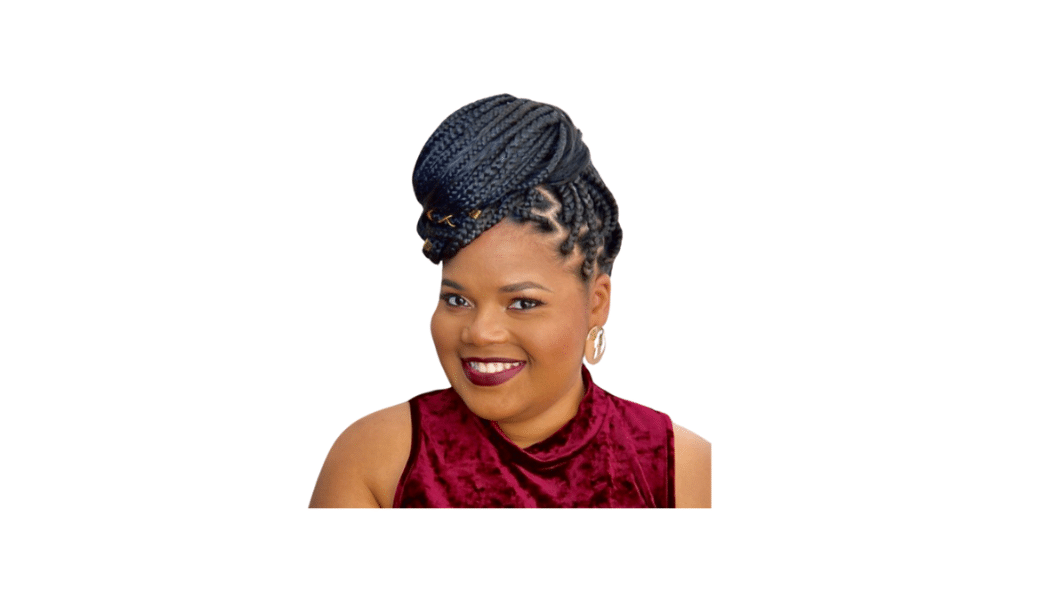
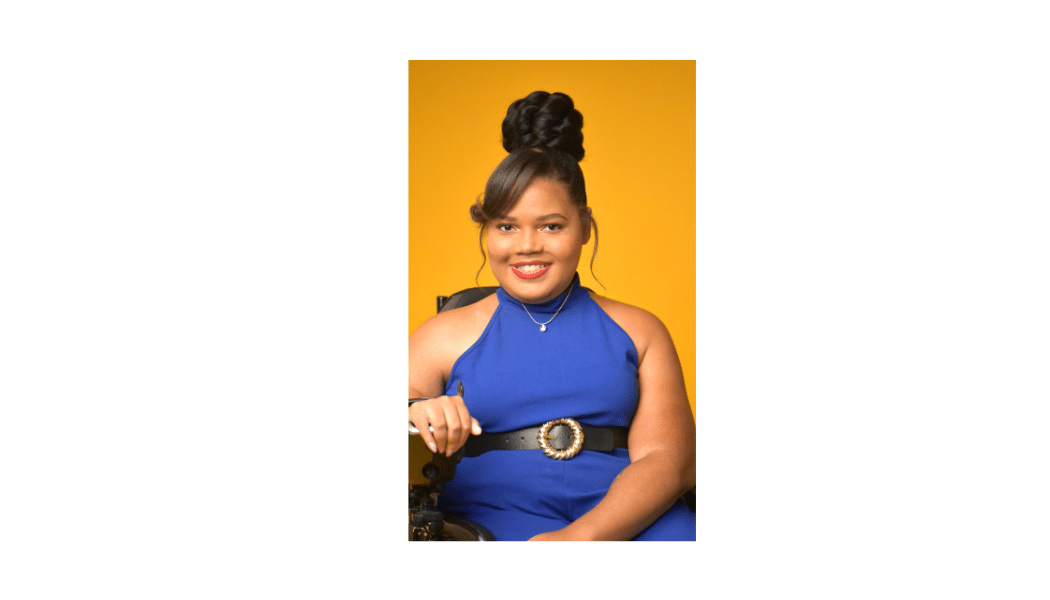
In the world of advocacy, some voices don’t just speak—they resonate. Candis, a 42-year-old powerhouse and founder of I AM ABLED Inc., is one of those voices. As a Black woman living with Spinal Muscular Atrophy (SMA), she has spent her career shattering the “invisible” glass ceiling that often separates the disability community from the rest of the professional world.
“I always wanted to make sure that wherever my voice was heard, it was valued, and I knew that being a Black woman in America that would be seen as a negative to many people. And then on top of it being a Black disabled [woman]. And I am educated, so I was a triple threat,” she tells BlackDoctor.
Her experience was a turning point, reinforcing her commitment to ensure that no matter the setting, she always presented herself as someone who had earned her place through hard work.
Understanding SMA: When Communication Breaks Down
For those unfamiliar with the condition, Candis describes SMA with striking clarity: “It’s basically where my nerves and muscles aren’t communicating together.” In SMA, the motor neurons fail to tell muscles what to do, leading to progressive weakness.
You May Also Like
Candis was diagnosed with SMA at just 18 months. Her mother first noticed a symptom when Candis consistently needed to use furniture to help herself stand up from the floor. This observation prompted multiple doctor visits until a specialist finally confirmed the diagnosis, highlighting her mother’s crucial role in identifying the condition early.
Candis was able to walk until a minor accident at age 12 resulted in a broken leg. The medical limitations of the era required her to be bedridden for eight months, which caused muscle atrophy. This ultimately led to her full-time transition to a wheelchair—a pivotal event she credits with changing her life’s path. It ignited a deep commitment in her to challenge the notion that “rolling” should ever be associated with “weakness.”
“When I go into a room, I want to roll in there with real leadership. On my arm, I actually have one of my favorite scriptures, which is ‘walk by faith, not by sight,’ but I translated that to ‘roll by faith, not by sight.’ To me, honestly, no matter if I’m rolling or standing still, you’re going to recognize me, you’re going to see me, and my voice will be heard,” Candis adds.
You May Also Like
RELATED: I Was Hit by a Car at 48 MPH, Here’s How I’m Redefining Disability
From Issa Rae to Public Advocacy
Candis’s career began in the heart of the entertainment industry. She interned at BET and DreamWorks, eventually serving as the executive assistant to Issa Rae for a decade—from the early days of Awkward Black Girl to the heights of HBO’s Insecure.
However, the lack of stability and guaranteed healthcare in entertainment forced a pivot. She moved into government and public policy, where she noticed a familiar trend: the total invisibility of disability representation.
“I was doing very well, working at a boutique public relations agency, but I realized I couldn’t do it anymore,” Candis recalls. “I had to ask myself: ‘One morning, when I can’t get up or I can’t make it to work, are they going to be understanding of my disability? When I can’t make it to that red carpet event or show up to work, are they going to be understanding?’ And I knew the entertainment industry was not going to be understanding.”
Rather than blending in, she decided to educate. She began bridging the gap between Diversity, Equity, and Inclusion and Accessibility (DEIA), teaching organizations that:
- Compliance is not Accessibility: Doing just enough to avoid a lawsuit isn’t true inclusion.
- Universal Design benefits everyone: A ramp helps a person in a wheelchair, but it also helps a mother with a stroller.
- Retrofitting is expensive; Planning is profit: Making things accessible from the start is a smart business move, not a burden.
“I did not want to be the only one in the office that understood disability. I didn’t want to be the only one who felt comfortable asking for reasonable accommodations—I didn’t want to be the only one, period. That was my motivation. I figured if I took the time to educate people, one person at a time, I could find my way,” she explains.
She argues that accessibility, including fundamental needs like travel, transportation, and healthcare, is not costly when it’s integrated from the beginning.
“I challenge America—I challenge America every single day. If I can fly into a city, why can’t I get an Uber? Why is that not an option for me? Why is that not available to me? If I go into a city in 2026, I should not have to wonder how I’m going to get from the airport to my hotel, and yet that is still a concern for many disabled people,” she shares.
A Leap of Faith: The Choice for Treatment
As an adult living with a rare disease, Candis recently made the decision to seek treatment, something that was deeply personal for her. For years, Candis was skeptical of clinical trials. But as she entered her 30s and noticed her hard-won independence slipping—simple tasks like applying lipstick became difficult—she decided to take a leap.
“I started to notice my independence, that I had fought so hard to keep, was kind of slipping away. And so I literally just said, ‘You know what? God, I’m huge on faith.’ I started to pray. I said, ‘You couldn’t have brought me this far to watch me disappear.’ So, no matter how skeptical I am of this—I don’t trust the drug, I trust God. It took me a year even after that to finally say okay, and it’s the best thing I’ve ever done,” she shares.
She began treatment with SPINRAZA, the first FDA-approved treatment for SMA, but she went in with limited expectations.
“I did not go into the trial thinking I was going to get up and walk. I had realistic expectations. I knew that if I could get even five percent of what I was seeing slip away back, that was enough for me,” she says. “But I knew that it was going to work, just based on my own relationship and faith with God. I knew it was going to work for me; I just didn’t know how much. I would never trade it.”
Candis wishes she had undergone the treatment earlier, as it helped her regain some of the independence she lost.
Advice for the Next Generation
Candis’s message to other Black women in corporate spaces is a radical call to self-care:
- Find your community: “There’s always one or two people on the team, or adjacent to the team, that you can find to connect with. You’ve gotta learn to step out and trust people. I had to find my community; I had to find the girls that would have my back so that when I was having a bad day—and you know, somebody tried it—they could give me the ‘calm down’ and help me remember the big picture.”
- Remember the “Big Picture”: “Never forget the big picture. As a Black woman in corporate America, you can never forget that the big picture is never in the office. The big picture is in your heart. What are you there for? Don’t let them confuse you. Remember your purpose, find your community, and know when to walk away.”
- Take rest: “Don’t give the job your heart and soul. You have to have a balance. As Black women, we tend to take on so much. We tend to take the job home while the boss is just chilling. So take your rest, babe. Don’t overwork yourself. You have nothing to prove—you are already there. You are already amazing, and you’ve already proved yourself. So take your rest.”
- Negotiate your worth: “Don’t sign up for 10,000 projects. Because guess what? When you do, they just keep giving them to you because you keep knocking it out of the park. So take your rest and continue to promote yourself and negotiate your salary. That’s the best advice I can give a Black woman in corporate America: Take your rest, find your community, and walk away. Don’t let the job take too much of you, because remember—it is just a job. And negotiate your salary.”
As she looks toward “40 and beyond,” Candis remains a paving stone for those coming behind her. Whether traveling the world to see Beyoncé or drafting government policy, she is proof that disability isn’t a death sentence—it’s a different, beautiful way of moving through the world.
“Whether you have a disability or not, don’t let it be the defining act. Live your life. Travel. If you want to do something, make it happen. There are always ways to make it happen. Follow the path that you want for it. Disability or not, follow the path that you want. You can make it accessible—we’ve got tools to make it accessible—but follow the path you want,” Candis concludes.