
• Skip to main content
  • Skip to secondary menu
  • Skip to primary sidebar
  • Skip to footer
BlackDoctor.org
Where Wellness & Culture Connect

Where Wellness & Culture Connect

  • Conditions
  • Wellness
  • Lifestyle
  • Longevity
  • Clinical Trials
  • Resources
    • Generational Health
    • Top Blacks in Healthcare 2025
    • Hall Of Fame
    • Clinical Trials Resource Center
    • Obesity Resource Center
    • Cancer Resource Center
    • Wellness on the Yard
    • Immunocompromised Care
    • BDO Resource Library
  • Find A Doctor
  • BDO TV
Home / Health Conditions / Melanoma / Dark Skin Isn’t Protection From Deadly Skin Cancer

Dark Skin Isn’t Protection From Deadly Skin Cancer

Contrary to what many believe, dark skin doesn't offer protection against deadly melanomas, an expert warns.

This type of skin cancer can be affected by genetics and is far more likely to develop on sun-protected areas of the body in blacks, Hispanics and even Asians, according to researcher Dr. Arthur Rhodes. He's director of the Melanoma Surveillance Clinic at Rush University Medical Center in Chicago.

"The misconception that the sun is responsible for all cases of melanoma leads to lower survival rates because of delayed diagnosis, particularly among people of color," Rhodes said in a Rush news release.

Only 10 to 15 percent of melanomas are caused by excessive sun exposure, typically in heavily freckled and sun-damaged skin, he noted.

You May Also Like
Psoriatic Arthritis Can Feel Beyond Your Control. Consider a Different Direction. Learn More Here. Psoriatic Arthritis Can Feel Beyond Your Control. Consider a Different Direction. Learn More Here.

A 2016 American Academy of Dermatology study found that while melanoma incidence is higher in whites, death rates from the cancer are higher among people of color.

"Far too often, black, Hispanic, and Asian patients with melanoma cancer tell us they believed that melanoma was only a danger for sun-seeking whites," the study authors wrote. "But anyone -- regardless of skin color -- may develop melanoma, in both sun-exposed and sun-protected sites. Not noticing or ignoring a new or changing mole in a sun-protected site can be fatal."

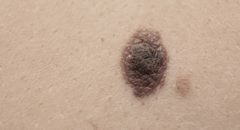
Early detection is crucial for melanoma survival. Rhodes stressed the need for monthly self-examinations and checks of difficult-to-see areas on the body to look for new moles or changes in size, shape or color of a pre-existing mole.

You May Also Like
Get GLP-1s Delivered to You As Low As $99/Month! Get GLP-1s Delivered to You As Low As $99/Month!

"Half of all melanomas in non-whites occur on the palms of the hands, soles of the feet, nailbeds, mucous membranes, perianal area, genitalia, and other areas that are not exposed to the sun, areas that are difficult-to-self-examine and commonly ignored," he said.

Melanoma in a hidden site can progress without symptoms or signs, leading to a delayed diagnosis that may result in an increased risk of death, especially for people of color, he added.

Risk factors for melanoma include a personal or family history of melanoma or other skin cancer, a mole that's present within two weeks of birth, having a lot of moles or having unusual moles, having a lot of freckles or red hair, and having multiple sunburns as a child, according to the Rush University dermatology department.

SOURCE: Rush University, news release, May 23, 2017

By Derrick Lane | Published June 5, 2017

June 5, 2017 by HealthDay News

The Latest In Melanoma

high fiber diet

Could Fiber Be the Missing Link to Better Cancer Treatment?

Melanoma is often thought of as a disease that primarily affects white patients, but that misconception has deadly consequences. While melanoma is less common in Black individuals, Black patients are significantly more likely to die from it. One of the read more about Could Fiber Be the Missing Link to Better Cancer Treatment?

6 Signs Your Mole May be Cancerous. Here’s How to Tell…

Spots and dots, being a freckled-faced person I am no stranger to these kinds of beauty marks. But, understanding the difference between unique beauty features, and dangerous moles can be difficult, yet so very important to our health. Our bodies read more about 6 Signs Your Mole May be Cancerous. Here’s How to Tell…
This Clinical Trial Extended the Life of Patients With Advanced Melanoma

This Clinical Trial Extended the Life of Patients With Advanced Melanoma

(HealthDay News) — A decade of patient follow-up finds a combo of two immunotherapy drugs can greatly extend survival for people with advanced melanomas. In 2011, a diagnosis of advanced, metastatic melanoma typically meant death within 6.5 months, noted researchers at read more about This Clinical Trial Extended the Life of Patients With Advanced Melanoma
skin cancer

How Skin Cancer Looks Different for Black People

According to the Skin Cancer Foundation, skin cancer only makes up about two percent of all the types of cancer that affect Black Americans. However, they still have worse outcomes. For example, the most common skin cancer that Black people read more about How Skin Cancer Looks Different for Black People
skin cancer

Beauty Mark Or Skin Cancer?

Skin cancer has been a hot topic lately. Are Blacks at risk? How do you get it? What does skin cancer look like? Contrary to popular belief -- that the high levels of melanin (a protective pigment) in our skin read more about Beauty Mark Or Skin Cancer?
Bob Marley

Black History of Health: Bob Marley

Almost 43 years ago, the world lost a legend when reggae artist Bob Marley died after a four-year struggle with melanoma skin cancer that started on his toe.   This may seem unusual, as melanoma is usually linked to patients with read more about Black History of Health: Bob Marley

Primary Sidebar

Subscribe to our newsletter

Icon

Caring for You, Too - Caregiver Workbook

1 file(s) 297 KB
Download

Trending Articles

10 Foods Your Liver Wishes You Would Would Stop Eating

healthy liver

The 7 Most Dangerous Leftovers to Reheat Are…

leftovers

Weight Loss Challenge: Lose 10 Pounds In 2 Weeks!

lose 10 pounds in 2 weeks

Stage 4 Lung Cancer: Why I Said Yes to a Clinical Trial

Stage 4 Lung Cancer: Why I Said Yes to a Clinical Trial

Top 10 Ways to Improve Your Digestion Naturally

digestion
Find a Culturally Sensitive Doctor

Footer

Where Wellness & Culture Connect

BDO is the world’s largest and most comprehensive online health resource specifically targeted to African Americans. BDO understands that the uniqueness of Black culture - our heritage and our traditions - plays a role in our health. BDO gives you access to innovative new approaches to the health information you need in everyday language so you can break through the disparities, gain control and live your life to its fullest.

Connect With Us

Resource Centers

  • Top Blacks in Healthcare
  • Clinical Trials
  • Wellness on the Yard
  • Cancer
  • Immunocompromised Care
  • About Us
  • Privacy Policy
  • Cookie Policy
  • Terms of Service
  • Careers
  • Advertise With Us
  • Advertising & Sponsorship Policy
  • Daily Vitamina
  • TBH

Copyright © 2025, Black Doctor, Inc. All rights reserved.