
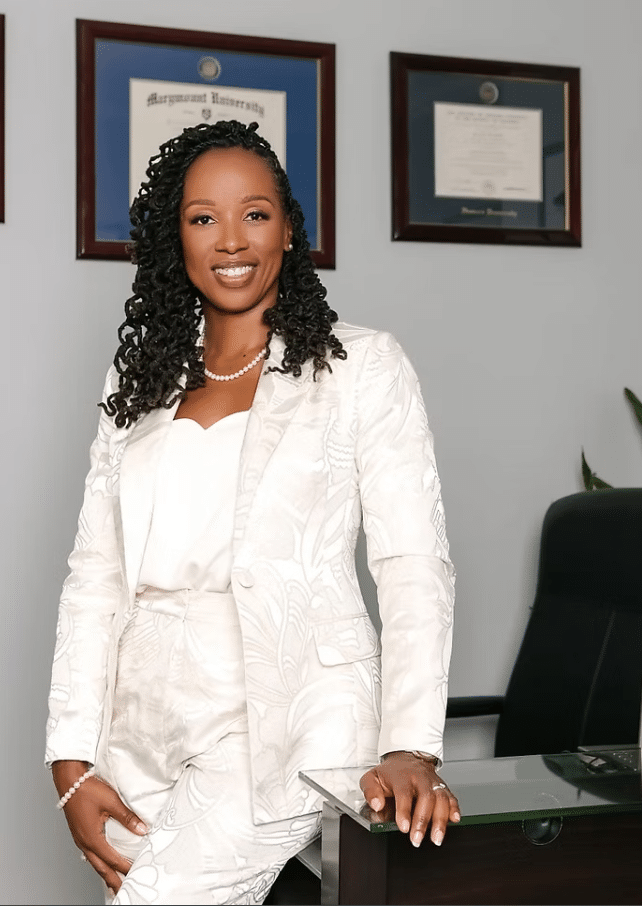
Dr. LaNail Plummer has spent years reshaping how Black women experience mental health care. As CEO of Onyx Therapy Group and department chair of counseling at Trinity Washington University, she’s built a career at the intersection of scholarship, training, and lived experience. Her newest work, The Essential Guide to Counseling Black Women, brings all of that together.
Why She Wrote the Book
Dr. Plummer says the book was driven by two groups she knows well: the clinicians who want to support Black women but don’t always know how, and Black women themselves who are navigating complex layers of identity, pressure, and expectation.
“I’m a Black woman, and so I’m always thinking about Black women. I’ve been drawn to the mental health field with a focus on Black women, and Black people in particular—Black women, Black children, and Black men. And I created Onyx Therapy Group as a reflection of that,” she tells BlackDoctor.
She points out that many clinicians complete a single multicultural course in their graduate programs, but that course rarely prepares them for the specific realities Black women face. Racism, patriarchy, and gendered expectations aren’t abstract theories—they shape daily life from childhood into adulthood.
You May Also Like

“Sometimes people want to see us as monolithic, or sometimes people want to just clump all of our intersections together into one space, but that’s not how it is. We show up as Black, and we show up as women. And when those two are combined, our experiences are different than Black men, and they’re different than white women or any other women of any other race. And so, I wrote the book with that in mind so that clinicians can understand how to treat a Black woman, bearing in mind our intersecting identities,” Dr. Plummer adds.
Part one of the book lays out that history plainly. It traces how racism and patriarchy shape identity, coping, vulnerability, and the pressure to appear strong at all times. That foundation helps readers—clinicians and Black women alike—see why certain struggles show up the way they do.
“Although The Essential Guide for Counseling Black Women sounds like it’s just for clinicians, it’s not. It’s for Black women. I would say at least 50 percent of the book… I’m speaking to Black women. I’m giving questions that they can ask themselves. I’m giving case studies that they can relate to. And I’m giving journal prompts that they can use to be reflective and introspective in their work,” Dr. Plummer notes.
You May Also Like

Addressing What Clinicians Often Miss
One of Dr. Plummer’s concerns is how often Black women are misread in therapy. Many are praised for strength, competence, or resilience, but those same qualities can cause their pain to be overlooked.
She gives an example: a client who is excelling at work or school may be praised so eagerly that no one stops to ask what she lost along the way—connection, rest, or relationships. Those losses deserve care, too.
“Sometimes Black women are overlooked in our vulnerability. Sometimes we’re overlooked in where we need support because we’re consistently seen as strong. I’ve seen so many Black women who were released from therapy prematurely because their clinician didn’t understand that there were other things that needed to be addressed,” she says.
There’s also the issue of diagnosis. Most major mental health disorders were researched and defined without Black women in the study populations. That means symptoms can present differently, and clinicians who rely too heavily on standard checklists may miss the real story. Dr. Plummer encourages therapists to look beyond lists and understand functionality, satisfaction, and lived experience.
“…What we look like when we are anxious looks different than when white men are anxious. What we look like when we are depressed looks different than when a white woman is depressed. When we are going through hormonal changes, it may look different than when somebody else is going through those hormonal changes,” she explains.
How Her Lived Experience Shapes Her Work
Dr. Plummer wrote the first draft of the book in the same tone she uses with close friends—direct, warm, and conversational. But she later caught herself adding more and more research, almost without thinking.
She realized she was trying to validate her voice for readers who might not naturally trust a Black woman’s expertise.
“One of the things that struck me was when I submitted the final draft, I was a bit disgusted by how much research I slipped into the book. The book was originally designed to simply be a guide, but I found myself adding research subconsciously to validate my voice because I know that some of the people reading the book wouldn’t be Black women, and they don’t always trust the voice of a Black woman,” Dr. Plummer notes. “They see our brilliance, they see our competence, but they don’t know the value of what we have to say unless it’s supported by what somebody else has to say. And I literally stumbled upon the fact that I somehow found myself with so much research.”
Naming that tension became part of the book’s purpose. It also became another reminder of why culturally responsive therapy matters—not only for clients, but for clinicians navigating their own identities.
Her Model for Clinical Supervision
While the first book focuses on counseling Black women, Dr. Plummer’s next book extends her framework into clinical supervision. Her CI-CS (Culturally Intersected Clinician Supervision) model helps supervisors understand how race, gender, learning style, and communication shape a clinician’s growth. The goal is simple: when clinicians feel psychologically safe, they grow. When they grow, clients benefit. And when clients benefit, so do families and communities.
Meant for More Than Therapy Rooms
Because the book is research-heavy and grounded in lived experience, it can be used far beyond clinical settings. Dr. Plummer says the same frameworks apply in education, justice systems, reentry programs, and policy discussions.
For example, she talks about how returning citizens often struggle with re-attachment after incarceration because prison demands a constant state of physical survival. Reunifying with family requires emotional safety and connection—skills that may need rebuilding. Those concepts appear throughout her book in the form of case studies, journal prompts, and practical tools.
“It’s a guidebook,” she says. “You open it to what you need in the moment.”
The Growth of Onyx Therapy Group
Onyx Therapy Group didn’t expand because Dr. Plummer was chasing markets. It expanded because Black communities were calling.
People in cities across the U.S.—and even abroad—asked whether she had clinicians in their area. When the requests kept coming, she took them as signs of where she needed to build next. The practice now includes more than 40 BIPOC clinicians and continues to grow with intention.
Her Message to Black Women Seeking Therapy
Dr. Plummer wants Black women to know that therapy isn’t only for crisis. It’s a space to think through decisions, explore identity, improve communication, and learn to care for ourselves in ways that feel grounded and sustainable.
“Your thoughts control your feelings and your actions,” Dr. Plummer says. “Therapy helps clear the mind so the actions that follow can be healthier.”
Her hope is that Black women will see themselves in the book, recognize old wounds, and feel supported as they confront them.
Where to Find Her Work
The Essential Guide to Counseling Black Women is available for preorder and will be released on January 27, 2026. You can purchase it through Norton, Amazon, Barnes & Noble, Target, Walmart, Audible, and many independent bookstores. It is also being published internationally, including in Australia.
You can keep up with Dr. Plummer on Instagram at @mahoganysunshine, and learn more about Onyx Therapy Group across social platforms and at onyxtherapygroup.com.