
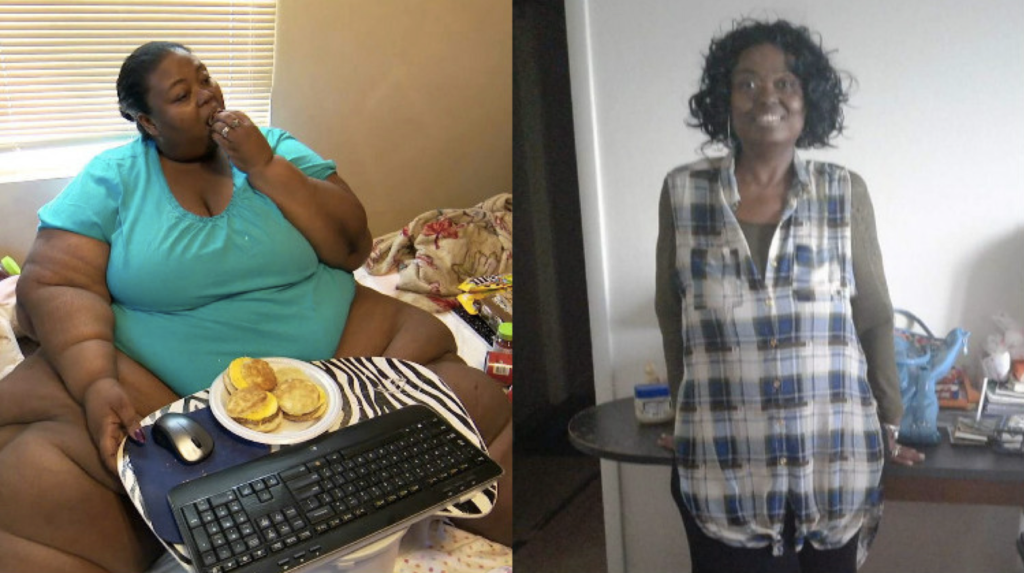
Its hard to believe that it’s been exactly 10 years since we first met Marla McCants on the TLC show, My 600-lb Life. She was morbidly obese, nearly 800-pounds and was desperately seeking help. Now, four years later after the show, Marla looks and sounds amazing! She’s lost nearly 500 pounds and is in the process of writing her book while staying active.
Marla’s weight loss problems stemmed from a list of traumatic experiences. According to a 2019 interview with the Rickey Smiley show, she was molested by her father when she was an infant until she was six-years-old. During an altercation with her high school sweetheart, Marla was abducted and held at gunpoint by her ex, which traumatized her greatly. Even worse, her former lover was on the loose for a while before getting arrested. The entire ordeal and its aftermath caused Marla to engage in emotional eating.
By the time her ex-boyfriend was caught by local authorities, Marla’s weight had already ballooned to around 700 pounds. During this time, Marla was already unable to move from her bed, and even simple tasks such as getting up and cleaning herself became next to impossible unless one of her three daughters helped her.
After a long and arduous process, however, Marla was able to qualify for gastric bypass surgery, as noted by an InTouch Weekly report. At the end of her My 600-lb Life featured episode, Marla weighed 534 pounds — 266 pounds less than her original weight. Marla was also incredibly optimistic when TLC’s cameras stopped filming.
You May Also Like

According to her website, the show was a wake up call that she needed.
“I weighed nearly 800 pounds,” admits McCants. “Even though I weighed that much, I never thought of myself being that size, that huge. Yes, I was big, but I was still able to walk. One day, I got ready to get out of bed to use the bathroom, and I could not put any weight on my feet. My feet hurt so bad that I went to the hospital just for them to tell me I had Gout. I believed the doctors at first because I had never heard of Gout. I knew then something had to change. I had to do something because I had seen and heard of stories about people being trapped in bed and dying.”
“I had worked as a nursing assistant in the past, with people who needed help. I never dreamed I would become one of them. I was an emotional wreck, having someone to take care of me that was not my style. I had to have a nurse aide to take care of me now. My first nursing aide was a woman named Toni (one of the many caretakers I have had). She was the one who talked me into reaching out for help. At first, I put up a fight, but as time went on, I surrendered and gave in. I emailed stars like Wendy Williams, Dr. Phil, and even Oprah, but no answer. Until one day, while watching TV, I came across a show called “My 600-pound Life.” I could identify with the people in their struggle with obesity.”
You May Also Like

“I wrote in and they contacted me back. This was the beginning of my breakdown and triumphs.”
Since then, Marla has pretty much continued in her weight loss journey. While she has not specified her current weight on her personal Facebook page, Marla’s latest uploads featuring herself show that she now looks like a completely different person. In recent interviews, it seems like Marla has found healing and has released her old, unhealthy lifestyle.
How to Lose 100 Pounds or More
Just like Marla, losing a lot of weight can be a hard task and is a major life transformation. To accomplish it takes a structured, sustainable approach that focuses on behavior, mindset, and consistency more than speed. Here’s a detailed step-by-step process to guide that journey:
1. Mindset & Goal Setting
- Define your “why.” Write down your personal reason for losing weight (e.g., health, longevity, confidence, mobility). This anchors you when motivation fades.
- Set realistic timelines. A healthy and sustainable rate is 1–2 pounds per week — meaning a 100-pound goal might reasonably take 12–18 months.
- Visualize milestones. Break your 100-pound goal into smaller targets (e.g., every 25 pounds). Celebrate each stage.
2. Get a Full Medical Assessment
- Visit your doctor to evaluate thyroid function, blood sugar, blood pressure, and metabolic markers.
- Discuss whether medical supervision or prescription aids (like GLP-1 agonists) might help.
- Identify any joint or heart issues that could affect your exercise choices.
3. Nutrition Overhaul
- Start with awareness: Track everything you eat for 1–2 weeks using MyFitnessPal or Cronometer to identify problem areas.
- Caloric deficit: Aim to eat 500–1,000 fewer calories per day than you burn (creates ~1–2 lb/week loss).
- Prioritize nutrient-dense foods:
- Lean proteins (chicken, fish, beans, Greek yogurt)
- High-fiber veggies and fruits
- Whole grains in moderation
- Healthy fats (avocados, nuts, olive oil)
- Avoid trigger foods: Processed snacks, sugary drinks, fried foods, and refined carbs.
- Meal prep weekly to avoid impulsive eating.
4. Build a Consistent Movement Plan
- Start gradually: Begin with walking or low-impact cardio (20–30 min/day).
- Add resistance training: Strength training helps preserve muscle mass and boost metabolism — even 2–3 days per week can make a big difference.
- Increase NEAT (Non-Exercise Activity Thermogenesis): Take stairs, park farther away, stretch or walk hourly if you sit often.
- Track activity: Use a smartwatch or app for accountability.
5. Monitor Progress Beyond the Scale
- If you haven’t already, start tracking:
- Body measurements (waist, hips, thighs, arms)
- Progress photos monthly
- Energy, mood, and sleep
- Understand that plateaus are normal — sometimes fat loss continues even if scale weight doesn’t move.
6. Address Emotional Eating & Habits
- Identify emotional or situational triggers for overeating (stress, boredom, celebration).
- Try mindful eating: pause, eat slowly, and stop when 80% full.
- Therapy, journaling, or a support group can help rebuild your relationship with food.
7. Create a Support & Accountability System
- Join online or local communities of people with similar goals.
- Work with a nutritionist, personal trainer, or health coach.
- Tell trusted friends or family members about your goals so they can help you stay on track.
8. Prioritize Sleep & Stress Management
- Sleep: Aim for 7–9 hours per night — poor sleep increases hunger hormones (ghrelin) and cravings.
- Stress reduction: Try yoga, meditation, deep breathing, or journaling. Chronic stress raises cortisol, which can hinder fat loss.
9. Reevaluate Every 6–8 Weeks
- Adjust calories as your body changes — you’ll need fewer calories as you lose weight.
- Modify workouts to prevent boredom and plateau.
- Revisit your “why” and reset short-term goals.
10. Transition from Weight Loss to Maintenance
- When close to your goal, slowly increase calories by 100–150 per week to find your maintenance level.
- Keep strength training — muscle preservation helps maintain your new weight.
- Continue habits that worked (meal prep, walking, hydration, tracking).
What Is Marla Up to Now?
Needless to say, Marla looks downright stunning in her latest pictures. The My 600-lb Life star looks like a completely changed woman. She seems happy, confident, and comfortable in her own skin.
On the season finale of My 600lb Life, doctors determined that she was only months – maybe even weeks – from dying. And even after a lengthy hospital stay and gastric bypass surgery, the 43-year-old still refused to let medical professionals help her stand up – and, in doing so, save her life.
Marla’s recovery seemed like a hopeless cause until it dawned on the mother-of-three that this was her last shot. If she didn’t get up, she would spend the rest of her very short life bedridden.

Because she was unable to get out of bed, she had to call an ambulance to transport her to her daughter’s car where she sat for the entire 13-hour drive.
Marla and her daughter Sierra moved to Houston, Texas, so she could work with weight loss expert Dr. Younan Nowzaradan, but following her surgery and a lengthy stay in the hospital, she was discharged because of her lack of cooperation.
But the trip almost killed her. A blood clot that had formed in her leg after years of not moving dislodged during the trip and traveled to her lung.
By the time she got to the hospital in Houston, her health was rapidly declining.
“She is in the worst condition health wise that I have ever seen,” Dr. Nowzaradan said.
But now, Marla is thriving, holds a number of different jobs including that of being a motivational speaker, and has an incredible story to tell. Keep going Team Marla!