• Skip to main content
  • Skip to secondary menu
  • Skip to primary sidebar
  • Skip to footer
BlackDoctor.org
Where Wellness & Culture Connect

Where Wellness & Culture Connect

  • Conditions
  • Wellness
  • Lifestyle
  • Longevity
  • Clinical Trials
  • Resources
    • Generational Health
    • Top Blacks in Healthcare 2025
    • Hall Of Fame
    • Clinical Trials Resource Center
    • Obesity Resource Center
    • Cancer Resource Center
    • Wellness on the Yard
    • Immunocompromised Care
    • BDO Resource Library
  • Find A Doctor
  • BDO TV
Home / Health Conditions / Kidney Disease / This Everyday Ingredient is Putting your Kidneys at Risk

This Everyday Ingredient is Putting your Kidneys at Risk

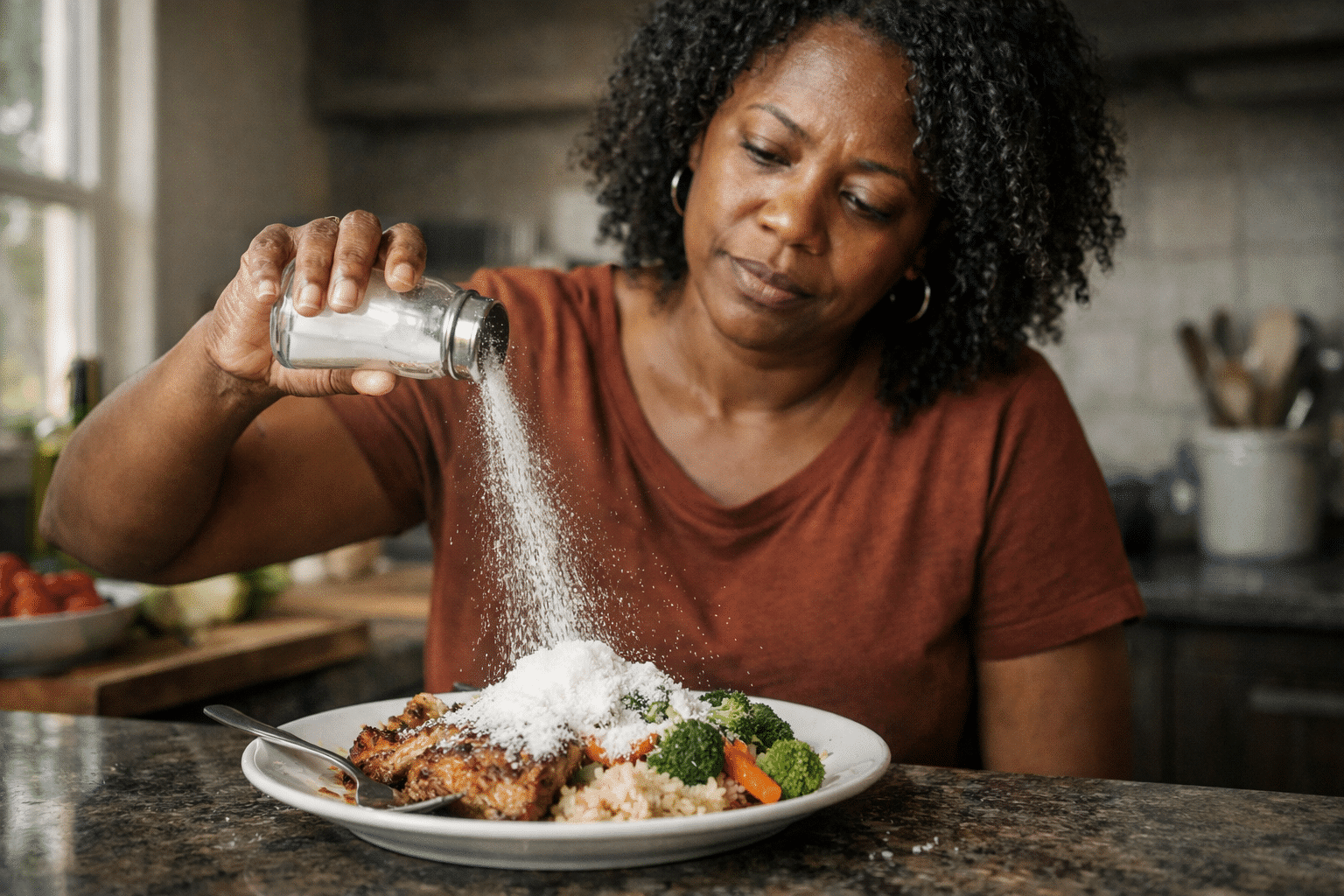
Aside from the Super Bowl, there are few things Americans are as passionate about as salt. Do you know Americans consumed as much as 53 million metric tons of salt in 2020 alone?

And yes, fast food vendors are aware of this Romeo-and-Juliet romance between Americans and salt; hence why they dutifully stack their products with salt. 

Salt – when modestly consumed – is an essential part of your diet. As one of the body’s core electrolytes, salt (in sodium) plays a critical role in regulating body fluids and enhancing muscle and nerve function. Furthermore, your body needs sodium to manage blood volume and pressure appropriately. 

You May Also Like
Psoriatic Arthritis Can Feel Beyond Your Control. Consider a Different Direction. Learn More Here. Psoriatic Arthritis Can Feel Beyond Your Control. Consider a Different Direction. Learn More Here.

However, salt quickly transits from hero to villain when it is immodestly consumed. This is particularly dangerous for people with kidney issues. 

Let us start by examining the effects of excessive salt consumption.

How dangerous is excess salt?

Malfunctioning kidneys struggle with managing excess salt in your body. This can result in an unhealthy accumulation of fluid and sodium.

You May Also Like
Get GLP-1s Delivered to You As Low As $99/Month! Get GLP-1s Delivered to You As Low As $99/Month!

How does this manifest? Swollen ankles, blood pressure hikes, and unnatural puffiness in sections of your body are some of the signals of your kidneys struggling to manage salt.

It is the kidney’s full-time job to dispose of excess water from the body. It performs this by filtering your blood. For your kidney to successfully execute this, it needs 

appropriate potassium-sodium equilibrium. 

When your diet contains unhealthily elevated levels of sodium, this equilibrium is disrupted. Consequently, your kidney lacks sufficient traction to pull water from the bloodstream’s walls. 

Ultimately, such a buildup of water and fluid can result in higher blood pressure. This commonly ends in kidney disease consequent to the substantial strain heaped on the kidney.

Aside from fluid intake, elevated levels of salt intake can result in increased urinary protein content. With more protein in your urine, the higher your kidney’s propensity to failure and cardiovascular disease.

What is the connection between salt and Kidney Stones?

According to The American Urological Association, of the 325 million people in the United States, 39 million will at one point in their life experience kidney stones.

READ: Kidney Stones: Who’s Most At Risk?

Wait, don’t mistake its prevalence for mildness. Kidney stones can be painful. More than the pains of urinating (especially as the stones pass through the patient’s urinary tract), kidney stones can cause nausea and even chronic kidney failure.

These stones are formed when specific chemical compounds coagulate in the urine, accumulating up into solid crumbs, like crystals. With the consequent buildup of these crystals, stones are formed. 

Salt is the principal culprit behind kidney stones. This commonly results from the heightened loss of calcium in urine. The condition called Hypercalciuria triggers hikes in the calcium content of the bloodstream.

The bulk of kidney stones get produced when oxalate merges with the calcium – say, in your urine. Hypercalciuria prevalently leads to

 kidney stones. This explains why 80 percent of kidney stones patients have been diagnosed with Hypercalciuria.

Studies have revealed that notable cuts in salt intake can dramatically reduce one’s propensity to kidney stones as well as slashing the amount of calcium excreted from the body via urine. 

Is salt bad for kidneys?

Let us not vilify salt too much, shall we? Your body still needs salt. For optimal performance, your body requires a daily intake of 186mg of sodium.

How much salt should you take then?

According to the Institute of Medicine (IOM), if you are healthy (and an adult), you can consume as much as 1.5grams of sodium daily.  

For the upper margin, the US Department of Health and Human Services – in agreement with the USDA (United States Department of Agriculture) and IOM – recommend that you shouldn’t consume more than 2.3g of sodium daily. 

For context, this is a teaspoon of salt. Take note that it is hazardous for hypertensive people to take more than 7g of sodium daily. 

So how do you slash your salt intake?

As always, when shopping for your groceries, be keen on the food labels. It suits you more to go with brands with relatively lower sodium content. 

Bear in mind that most acclaimed specialty low-sodium foods produced with salt alternatives end up being loaded with potassium. This is as wasteful as robbing Peter to pay Paula because a high potassium intake is equally dangerous.

Now, if you fancy substituting salt in your meals, there are a handful of healthy spices and herbs to go with. Cinnamon, mint, rosemary, and basil count among this healthy bunch.

When you go out to get cooked meals, respectfully request for your fish and meat to be prepared without (or very minimal amounts of) salt. Lastly, frozen foods – just like processed and canned foods – are usually heaped with salt.


By Lotus Felix | Published August 10, 2021

The Latest In Kidney Disease

kidney care

The Concern Still Exists on the Kidney Patient Act – Make Your Voice Heard

Watch this video Kidney disease is devastating Black communities—and the crisis is deepening. While over 1 in 7 U.S. adults lives with chronic kidney disease (CKD), Black Americans are three times more likely than white Americans to develop end-stage kidney read more about The Concern Still Exists on the Kidney Patient Act – Make Your Voice Heard
kidney transplant

My Story: “My Kidney Transplant Failing Was a Blessing in Disguise”

Kidney disease is often described as a lifelong journey—one filled with twists, setbacks, victories, and unimaginable resilience. For Anthony Tuggle, the journey began with a routine doctor visit that led to a life-changing diagnosis. What followed was a story of read more about My Story: “My Kidney Transplant Failing Was a Blessing in Disguise”
APOL1

Nearly 35% of People with Kidney Failure are Black – Why?

You read that right. Kidney failure, known in medical circles as end-stage renal disease (ESRD), casts a heavy shadow over Black folks in the United States. Nearly 35 percent of those grappling with this condition are Black, even though they read more about Nearly 35% of People with Kidney Failure are Black – Why?
Foamy Urine Causes

Why Foamy Urine is a Serious Symptom That Leads to These Diseases

After going to the bathroom, ever look back and see what your urine looks like? Sure, we've all done it from time to time, but what do you do if your urine looks foamy? Never thought about it? You're not read more about Why Foamy Urine is a Serious Symptom That Leads to These Diseases
signs of kidney disease

15 Signs of Kidney Disease Black Folks Shouldn’t Ignore

Kidney disease disproportionately affects Black communities, with Black Americans nearly four times as likely to develop kidney failure compared to other racial groups. Many people don’t notice the early warning signs of kidney disease until the condition has progressed, making read more about 15 Signs of Kidney Disease Black Folks Shouldn’t Ignore
stem cell transplant

6 Ways to Treat Transplant Side Effects

If you haven’t heard of organ and stem cell transplants by now, you’re in for quite the surprise. Cutting-edge procedures that are truly revolutionizing healthcare, these cell-based treatments can do a lot for all kinds of conditions.  But it’s not read more about 6 Ways to Treat Transplant Side Effects

Primary Sidebar

Subscribe to our newsletter

Icon

Caring for You, Too - Caregiver Workbook

1 file(s) 297 KB
Download

Trending Articles

Weight Loss Challenge: Lose 10 Pounds In 2 Weeks!

lose 10 pounds in 2 weeks

Stage 4 Lung Cancer: Why I Said Yes to a Clinical Trial

Stage 4 Lung Cancer: Why I Said Yes to a Clinical Trial

Top 10 Ways to Improve Your Digestion Naturally

digestion

This Clinical Trial Is Making HIV Treatment Easier for Black People

This Clinical Trial Is Making HIV Treatment Easier for Black People

A Clinical Trial Extended the Life of Women With Hard-to-Treat Breast Cancer

A Clinical Trial Extended the Life of Women With Hard-to-Treat Breast Cancer
Find a Culturally Sensitive Doctor

Footer

Where Wellness & Culture Connect

BDO is the world’s largest and most comprehensive online health resource specifically targeted to African Americans. BDO understands that the uniqueness of Black culture - our heritage and our traditions - plays a role in our health. BDO gives you access to innovative new approaches to the health information you need in everyday language so you can break through the disparities, gain control and live your life to its fullest.

Connect With Us

Resource Centers

  • Top Blacks in Healthcare
  • Clinical Trials
  • Wellness on the Yard
  • Cancer
  • Immunocompromised Care
  • About Us
  • Privacy Policy
  • Cookie Policy
  • Terms of Service
  • Careers
  • Advertise With Us
  • Advertising & Sponsorship Policy
  • Daily Vitamina
  • TBH

Copyright © 2025, Black Doctor, Inc. All rights reserved.